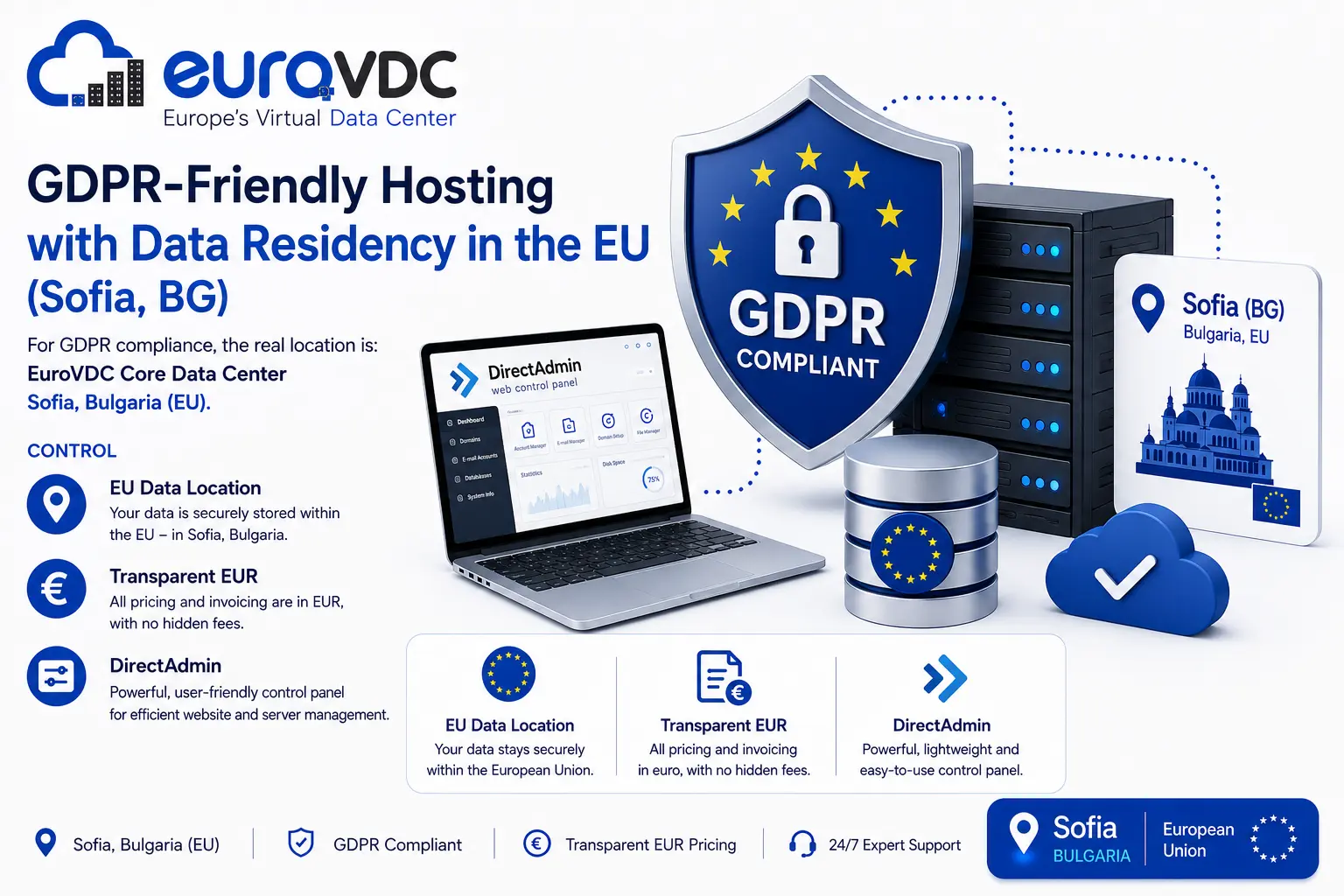


European-standard data security is a controls problem first—and a map pin second. GDPR raised expectations for how personal data is protected in systems you run, not only whether the rack sits in the EEA. This guide focuses on security posture for Sofia (EU) workloads on EuroVDC: encryption, access, backups and evidence. It is not another “why host in the EU?” essay, nor a city cutover checklist.
Apply controls on web hosting or isolated cloud server environments—product choice follows risk, not slogans.
Security controls GDPR buyers actually ask for
- Encryption in transit: HTTPS on every public endpoint; TLS for admin, mail submission and APIs.
- Access hygiene: MFA on panels, SSH keys over passwords, least-privilege DB users, no shared root in chat.
- Separation: staging ≠ production; secrets out of git; admin paths restricted.
- Backup integrity: off-box copies, defined retention, restore tests—not only “backup enabled.”
- Logging with purpose: enough to investigate incidents; retention aligned to need, not infinite storage.
- Vendor clarity: who is controller vs processor; DPA/AVV signed; subprocessors known.
Geography (Sofia in the EU) reduces transfer friction for that dataset. It does not replace the list above. Treat location as one answer on a questionnaire—never as a substitute for access reviews, restore drills or a signed processor agreement.
When auditors ask “how is data secured?”, lead with controls and evidence. Mention Sofia (EU) as the processing footprint after the technical story is solid.
What “European standard” means in practice
- Risk-based hardening: protect what you process—customer accounts, invoices, tickets—proportionate to impact.
- Defence in depth: TLS + patching + backups beat a single “compliant DC” claim.
- Evidence: be ready to show access policy, renewal of certificates, last restore drill and incident contacts.
- Honest notices: state processing location truthfully (Sofia/EU)—never invent a Western hub for optics.
Counsel still owns lawful basis and DPIA depth. Hosting choices support security; they do not certify your whole organisation.
Hosting vs cloud for control depth
| Need | Web hosting | Cloud (KVM) |
|---|---|---|
| Panel HTTPS + managed stack | Strong fit | You manage more |
| Custom firewall / OS lockdown | Limited | Root control |
| App + DB with personal data at scale | Often tight | Better isolation |
| Ops maturity required | Lower | Higher |
Dedicated enters when contracts demand single-tenant metal—evaluate on dedicated server only after metrics or wording force it.
Sofia EU without mythology
EuroVDC places hosting and cloud in Sofia (EU). Use that fact in questionnaires and privacy copy, then prove controls. Buyers tired of brochure GDPR copy notice when access and restore stories are empty.
Frequently asked questions
Does Sofia hosting make me GDPR compliant?
No. EU location helps transfer posture; compliance still needs lawful basis, DPA, security controls and processes you own.
Is this the same as “why EU hosting” posts?
No. Those argue location benefits. This piece is controls-first data security for European-standard expectations.
Hosting or cloud for personal data?
Small CMS: hosting with HTTPS and backups. Custom apps needing root/isolation: cloud. Measure sensitivity and ops skill.
What evidence should I keep?
Access policy, TLS status, backup restore dates, DPA, subprocessor notes and an incident contact tree.
Where do EuroVDC servers run?
Sofia (EU)—state that accurately in notices.
How do I start on EuroVDC?
Pick web hosting or cloud server, enable HTTPS, harden access, then document restores.