

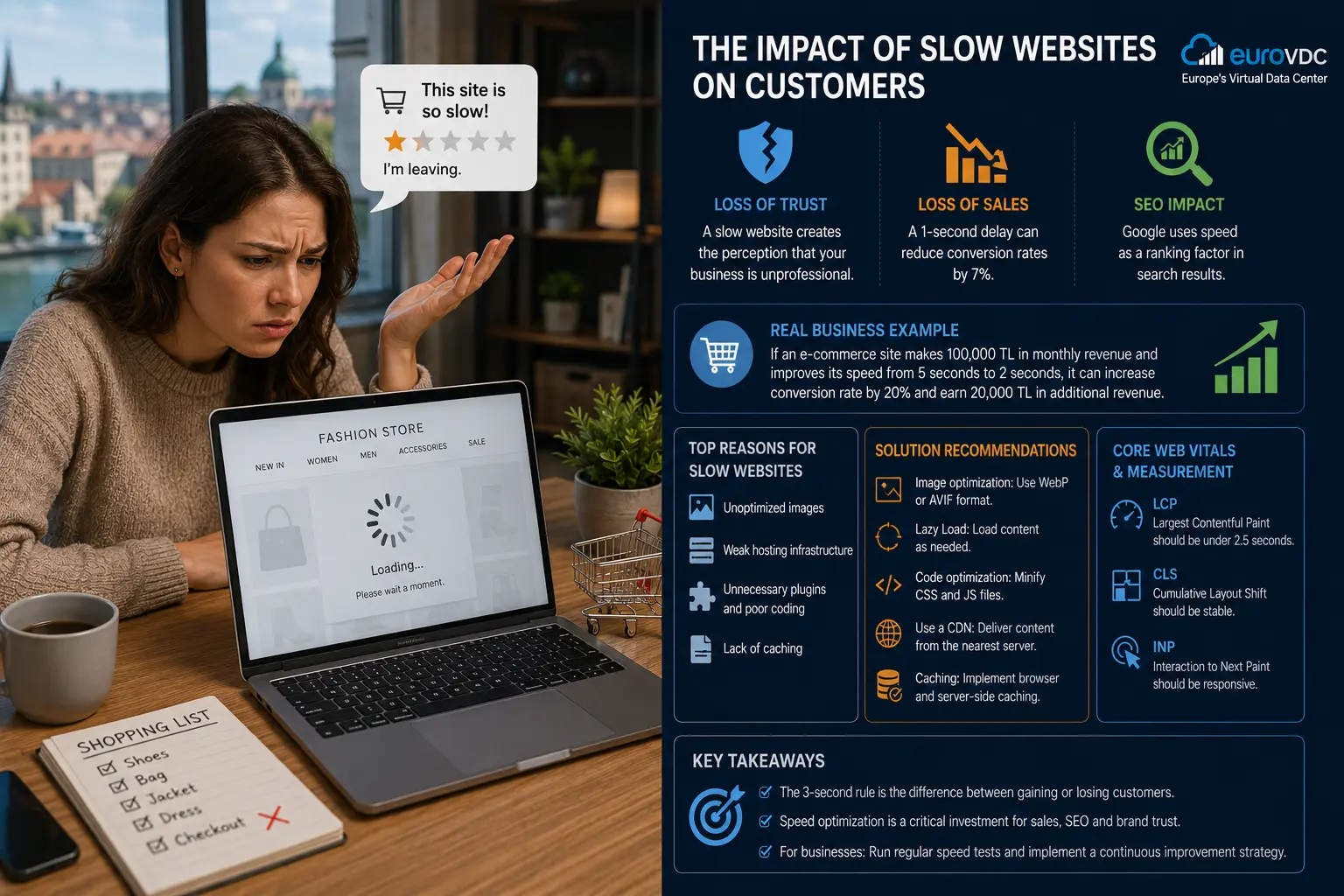
If the page is still blank after about three seconds, many visitors leave—before your offer, trust copy or checkout even appears. The “3-second rule” is a blunt UX heuristic, not a physics law, but it matches how impatient mobile networks and paid ads punish slow origins. This guide turns that pressure into a hosting decision for Sofia (EU) sites on EuroVDC.
Fix stack and origin together: start on solid web hosting; move to cloud server when you need root, cache daemons or custom runtimes.
What “three seconds” actually includes
- DNS + TLS + TTFB: time until the first byte from your origin or edge.
- HTML + critical CSS/JS: render-blocking assets that keep the screen empty.
- Third parties: tags, chat widgets and pixel storms that inflate LCP.
- Backend work: uncached PHP/MySQL, cold caches, missing indexes.
Blaming “the internet” without measuring TTFB vs front-end weight wastes money. Measure with Web Vitals and a simple waterfall from the regions your buyers use. A homepage that paints in under three seconds on Wi‑Fi but stalls on mid-range mobile still fails the rule that matters commercially.
Paid traffic makes the cost obvious: every second of blank screen burns ad spend before the landing page can convert. Organic visitors are quieter but leave just as fast.
Performance checklist that moves the needle
- Cache HTML/API where safe; avoid regenerating the homepage on every hit.
- Compress images; lazy-load below the fold; serve modern formats when practical.
- Trim JS; defer non-critical scripts; kill unused plugins.
- DB hygiene: indexes on hot queries; object cache (Redis) when the app supports it.
- CDN for static when audiences are spread; keep dynamic origin honest in Sofia for EU users.
- Right-size the host: overloaded shared neighbours or undersized VMs show up as TTFB spikes.
When hosting is enough vs when cloud wins
| Signal | Stay on hosting | Move to cloud |
|---|---|---|
| Brochure / light CMS | Usually yes | Overkill |
| Need Redis/Docker/custom PHP | Limited | Root fits |
| Traffic spikes / campaigns | Until pegged | Resize VM |
| Slow TTFB after front-end trim | Check plan/neighbours | Isolated CPU/RAM |
Dedicated metal is a later step for sustained I/O—not the first answer to a heavy theme.
Sofia EU latency framing
EuroVDC hosting and cloud run in Sofia (EU). For Central and South-Eastern European audiences that often means competitive origin latency; Western EU is still practical for many SaaS and shop workloads. Combine location with caching—geography alone will not save a 4 MB hero image.
Frequently asked questions
Is three seconds a hard SEO rule?
No. It is a UX heuristic. Core Web Vitals and conversion data matter more than a round number—but slow starts still lose people.
Will a faster plan alone fix my site?
Only if origin CPU/RAM or neighbour noise was the bottleneck. Bloated front ends need code work too.
Hosting or cloud first?
Start on web hosting for simple sites. Choose cloud when you need root, custom caches or measurable isolation.
Does Sofia help Western EU visitors?
Often enough for dynamic apps; add CDN for global static. Measure from your real markets.
What should I measure weekly?
LCP, TTFB, error rate and checkout completion—especially after deploys and campaigns.
How do I proceed on EuroVDC?
Trim assets, then size on web hosting or cloud server in Sofia.