

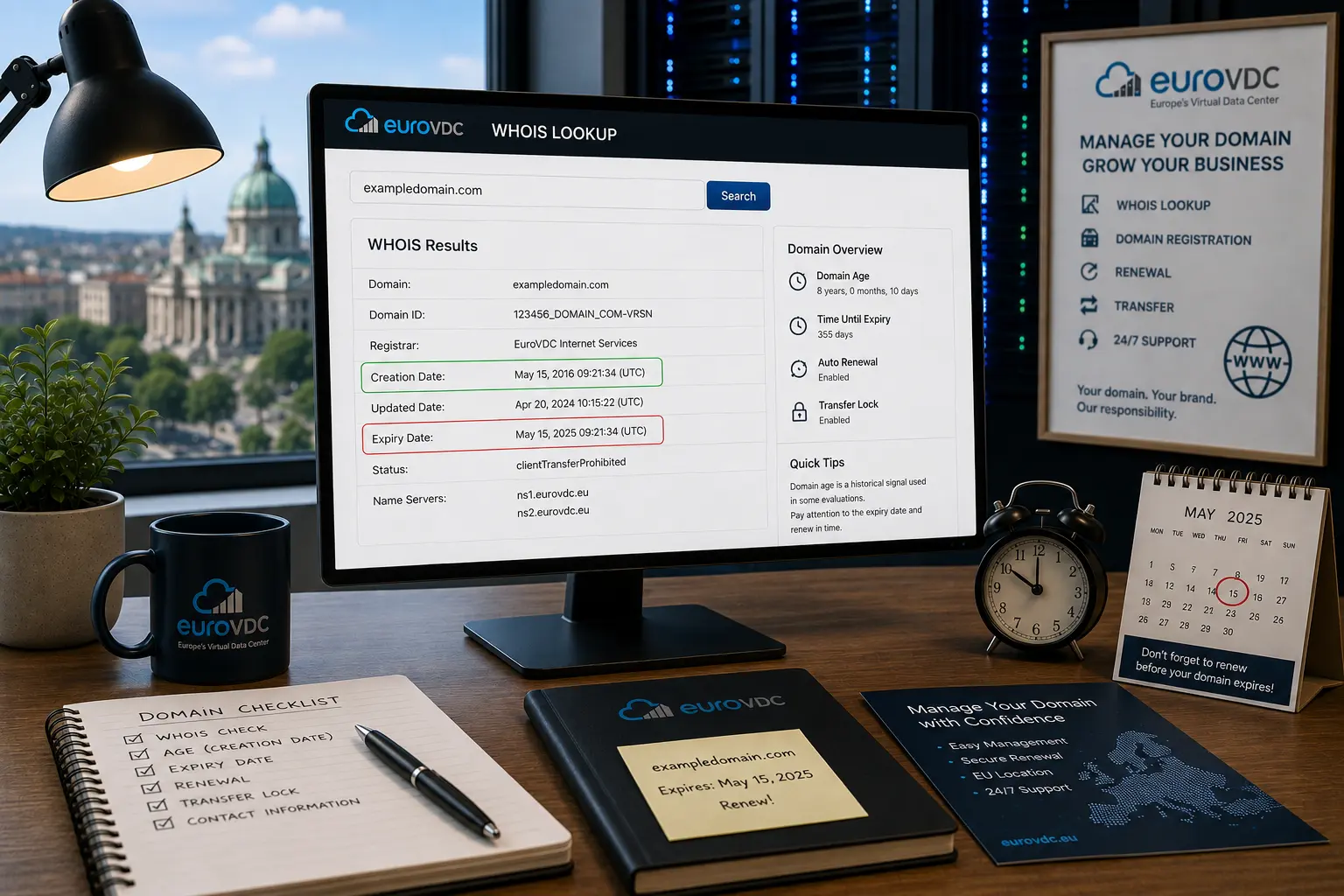
Domain age is the time since the creation date in the registry. Expiration is when the current paid term ends. Both appear in Whois/RDAP and both are operational facts—not SEO magic. Reading them correctly helps you renew on time, judge aftermarket risk and ignore bad advice about “aged domains.”
Verify any name with EuroVDC Whois lookup before you buy, renew or build a campaign around it.
Creation date: what it does and does not mean
Creation date marks first registration at the registry (or the last time the name re-entered after deletion, depending on history). A ten-year-old creation date can mean a stable brand—or a parked shell with no trust signals. Search engines care about content quality, links and technical health far more than raw age.
Also note: privacy products and registrar changes do not reset creation date. Transfers keep the same registry object; only a delete-and-recreate cycle produces a new creation timestamp.
Expiration and what happens next
Expiry is the end of the registration term you paid for. Auto-renew, if enabled, usually charges before that date. If renewal fails:
- Grace period: Short window where the registrant can still renew at normal or near-normal rates (exact length varies by TLD/registrar).
- Redemption period: Higher recovery fees; the name may not resolve. Act fast with the current registrar.
- Pending delete / drop: The name returns to the pool; anyone may register it once available.
Never assume global timelines—gTLDs and ccTLDs (.eu, .bg, .tr) publish their own schedules. Check your panel and Whois expiry together.
How to query age and expiry
- Open Whois lookup and enter the full domain.
- Read creation and expiration (or paid-until) fields.
- Note updated date—recent changes may signal transfer, DNS or contact edits.
- Scan status for holds or pending delete.
- Confirm nameservers still match the service you expect.
For names you want to register fresh, use domain search; Whois alone does not reserve availability.
SEO myths about domain age
- “Older always ranks higher.” False as a rule. Thin aged domains lose to strong new sites constantly.
- “Buy expired domains for instant authority.” Risky: spam history, toxic links and brand confusion can hurt more than help.
- “Whois age equals Google trust.” Engines evaluate the site you ship, not the registry birth certificate.
- “Changing registrars resets age.” No—creation date stays with the registry object.
Operational habits that matter more than age
Enable auto-renew on production domains, keep billing contacts current, set calendar reminders 30–60 days out and document Auth codes only when transferring. EuroVDC as an EU (Sofia) registrar keeps renewals and Whois checks in one account alongside hosting when you need them.
Buying aftermarket names
When evaluating a used domain, combine Whois dates with archive history, backlink quality and trademark clearance. A clean creation date with a polluted past is still a bad purchase. Prefer names without redemption drama and with clear seller authority.
Frequently asked questions
Where do I see domain age?
In Whois/RDAP creation date. EuroVDC Whois lookup surfaces it with expiry and status.
Does transferring to EuroVDC change creation date?
No. Transfer moves sponsorship; the registry creation timestamp remains.
How long is the grace period?
It depends on the TLD and registrar policy. Treat published schedules as authoritative and renew early instead of relying on grace.
Can I recover a domain in redemption?
Often yes, through the current registrar for a redemption fee, while the status allows it. After pending delete completes, recovery via the old account usually ends.
Is an old domain better for email deliverability?
Not automatically. Deliverability depends on authentication (SPF/DKIM/DMARC), reputation and content—not creation date alone.
How do I check expiry before a campaign launch?
Run Whois, confirm expiration and auto-renew in the panel, and renew if the date is inside your campaign window plus buffer.
Check dates now
Read creation and expiry in one place: Whois lookup.