

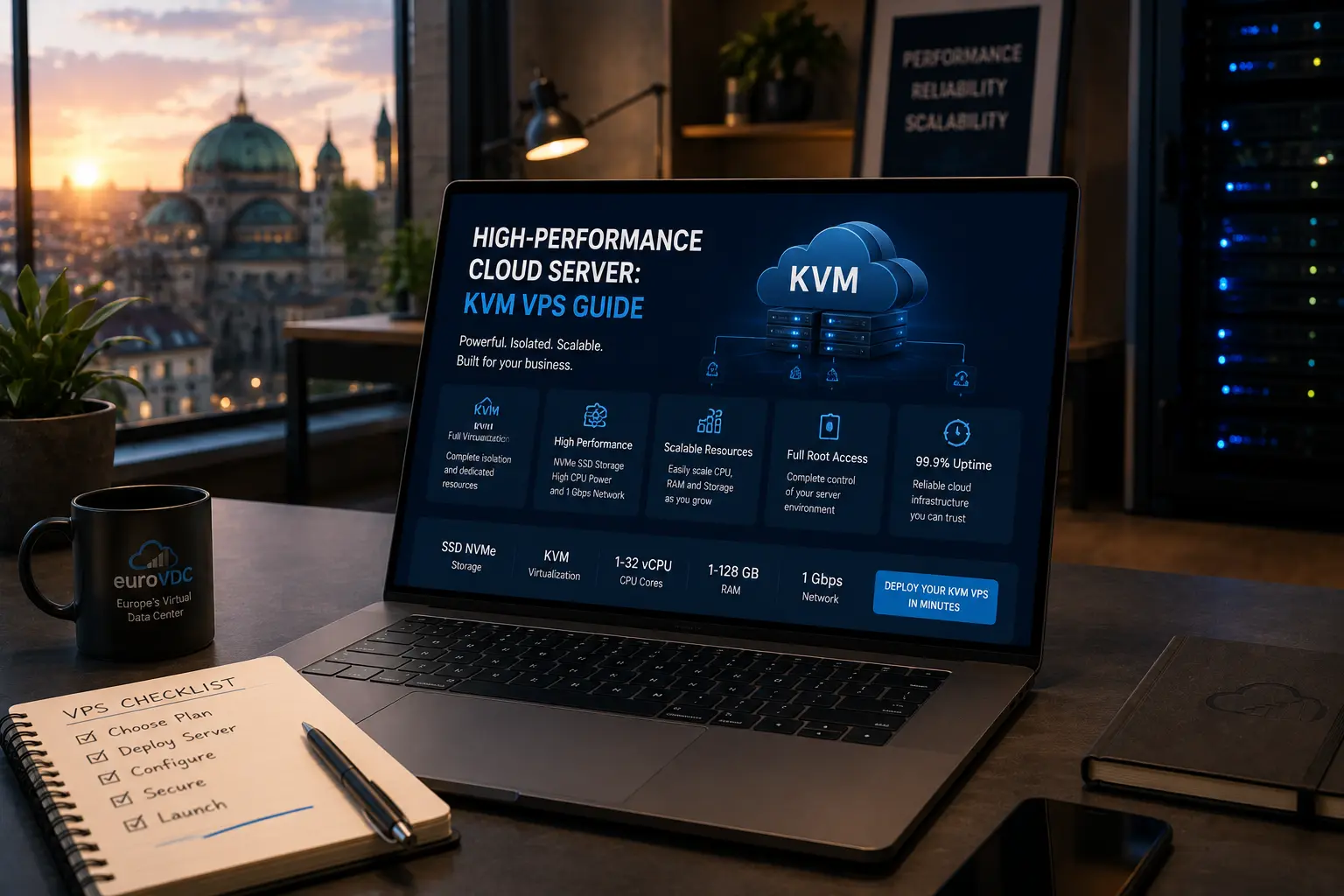
High-performance cloud is not a marketing label—it is a sizing discipline. CPU, RAM and NVMe must match the bottleneck you actually measure. This guide is a practical KVM VPS checklist for teams that need predictable latency and I/O on EuroVDC cloud servers in Sofia (EU).
Compare plans on cloud server. Shared sites that do not need root should stay on web hosting.
What “high performance” means on KVM
KVM gives each guest its own kernel and allocated slices of CPU, RAM and disk. Performance appears when: (1) the allocation is large enough for peak, (2) storage is fast enough for the database, and (3) you are not swapping or thrashing under cron spikes. Full virtualisation isolates noisy neighbours better than crowded shared platforms—but undersizing still kills apps.
CPU checklist
- vCPU count vs concurrency: PHP-FPM, Node and Java workers need cores for parallel requests; idle single-thread apps do not.
- Burst vs sustained: Campaign traffic and batch jobs differ—size for the longer of the two peaks you care about.
- Steal / ready time: Monitor hypervisor wait signals; chronic steal means resize or move workload.
- Pin heavy jobs: Separate build agents and production if compile jobs steal transactional CPU.
More cores do not fix a single-threaded bottleneck. Profile before you buy.
RAM checklist
- Working set: App + DB buffer + OS + cache must fit without swap on the hot path.
- Object cache: Redis/Memcached pay for themselves when page generation is CPU-heavy.
- Headroom: Leave 20–30% free for traffic spikes and kernel caches.
- OOM patterns: Sudden kills after deploys usually mean memory leaks or undersized plans—not “bad cloud.”
NVMe and I/O checklist
- Prefer NVMe-backed plans for databases, queues and frequent small writes.
- Separate logs from data volumes when disk fills unpredictably.
- Watch iowait and disk latency under checkout or report jobs.
- Snapshot and backup I/O counts as load—schedule heavy backups off peak.
CPU looking fine while pages crawl often means disk or lock contention. Measure IOPS and latency, not only load average.
Day-one performance baseline
- SSH keys, firewall, updates before production DNS.
- Baseline: CPU steal, RAM used, disk latency, app p95 for one quiet day and one busy day.
- Enable HTTPS early so TLS cost is in the baseline.
- Document resize triggers (e.g. sustained >70% RAM for 24h).
Root access means you own tuning. High performance is ops habit plus correct plan, not a sticker on the order form.
When to stay shared or go dedicated
Brochure WordPress without custom daemons belongs on web hosting. Sustained extreme I/O, specialised hardware or contractual single-tenancy may need a dedicated server. Most growing SaaS and ecommerce apps sit comfortably on Sofia KVM cloud for a long time.
EuroVDC approach
Order a Sofia KVM on cloud server, size to the measured bottleneck (CPU, RAM or NVMe), harden day one and resize from metrics. Pair with SSL certificates so security and performance baselines stay honest.
Frequently asked questions
Is more vCPU always faster?
No. Single-threaded apps and saturated disks ignore extra cores. Profile first, then scale the scarce resource.
Why does NVMe matter for cloud VPS?
Databases and queues are I/O sensitive. Faster local NVMe cuts latency when the hot path hits disk frequently.
How do I know I need more RAM?
Chronic swap, OOM kills or DB buffer pool thrashing under normal traffic. Free RAM alone is not the goal—stable working set is.
Can I run Docker on EuroVDC cloud?
Yes within plan limits: KVM gives your own kernel. Size CPU/RAM for containers plus the orchestrator overhead.
Shared hosting or high-performance cloud?
Shared for managed sites without root. Cloud when you need isolation, custom stacks or predictable resources under load.
How do I start with EuroVDC?
Choose a plan on cloud server, boot the OS, harden SSH/firewall, set backups and measure a week before you upsell yourself.