
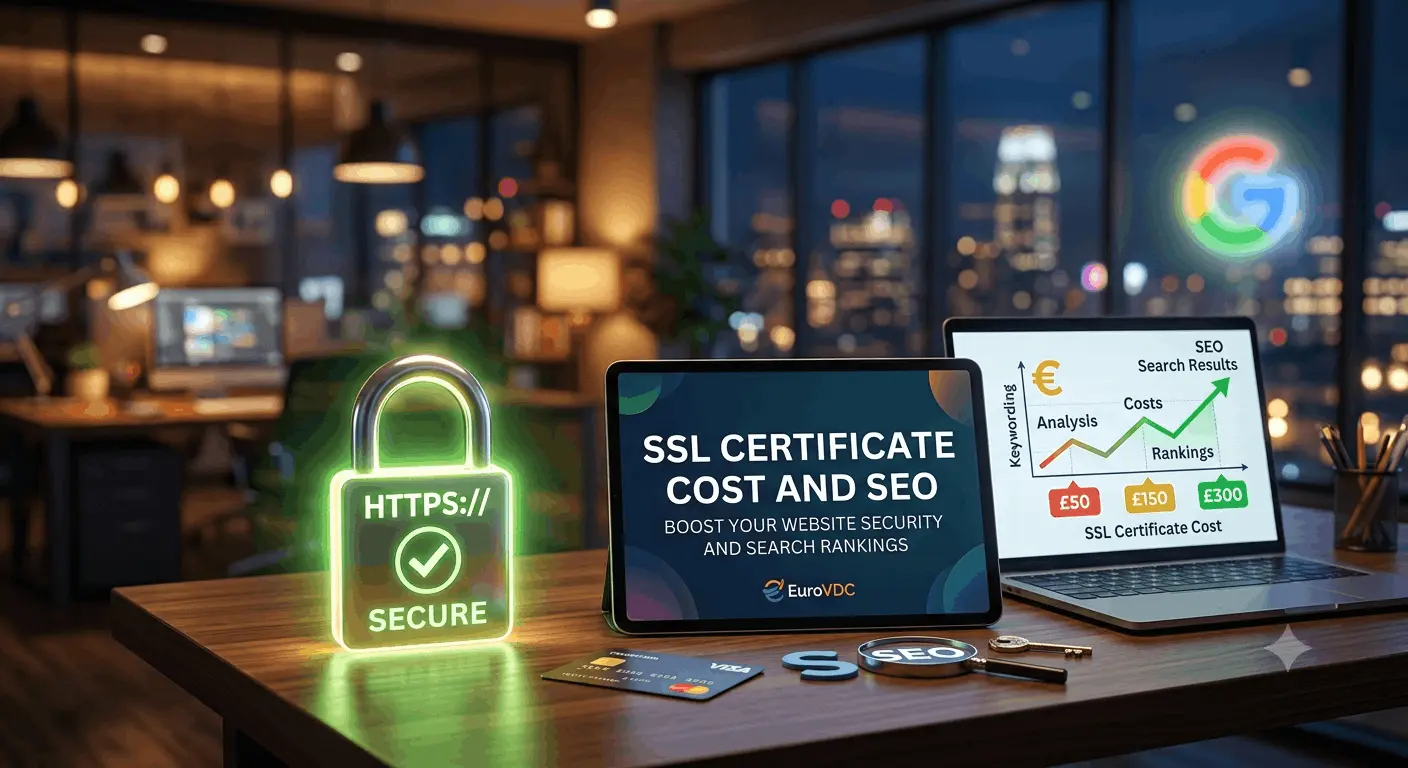
SSL cost is often misunderstood. Free certificates can secure a site correctly; paid products buy validation depth, warranties or wildcard convenience—not a secret Google boost. This guide compares free vs paid SSL, when wildcard pays off and what HTTPS actually does for SEO—then points to EuroVDC certificates for Sofia (EU) hosting.
Browse options on SSL certificates. Pair them with web hosting or cloud once the chain is clean.
What you are paying for
- Encryption: Free and paid DV certs encrypt traffic the same way browsers expect.
- Validation depth: OV/EV prove more about the organisation; useful for brand and procurement, not ranking algorithms.
- Coverage model: Single domain, multi-SAN or wildcard (*.example.com) changes price and ops effort.
- Support and warranty: Commercial CAs package SLAs and insurance caps; evaluate if your risk model needs them.
- Automation: Auto-renew saves outages—price that operationally, not only on the invoice.
Budget for monitoring and renewal labour. A “cheap” cert that expires mid-campaign is expensive.
Free vs paid: decision matrix
| Need | Free DV | Paid DV/OV | Wildcard |
|---|---|---|---|
| Padlock + SEO hygiene | Usually enough | Optional | If many subdomains |
| Many staging/api hosts | Many certs | SAN packs | Often cheaper ops |
| Enterprise questionnaires | May ask for OV | Better fit | Orthogonal |
| Budget-sensitive SME | Start here | Upgrade later | When subdomain count grows |
SEO engines care that HTTPS works with correct redirects—not which commercial logo is on the certificate.
Wildcard: when the premium is rational
Wildcard certificates cover arbitrary subdomains under one name. They shine when you spin up preview hosts, regional frontends or service subdomains weekly. They are weaker hygiene if every subdomain shares one private key forever—rotate and limit who can issue CSR/keys. For a single shop on www + apex, a standard DV cert is usually enough.
SEO impact without myths
- HTTPS is a confirmed but modest ranking signal.
- Browser warnings destroy CTR and conversions—bigger than the ranking nudge.
- Mixed content and broken chains undo the benefit.
- Consistent canonicals and 301s from HTTP → HTTPS matter more than EV.
Treat SSL as trust and crawl hygiene. Content quality and Core Web Vitals still dominate rankings.
Cost control habits
- Inventory every hostname that needs HTTPS before buying wildcard “just in case.”
- Prefer auto-renew and calendar alerts 30/14/7 days out.
- Keep one preferred host (www or apex) to avoid duplicate cert and SEO clutter.
- Test the full chain on mobile networks after install.
EuroVDC approach
Issue or renew via SSL certificates on Sofia hosting or cloud. Start with the smallest product that covers real hostnames; upgrade to wildcard or organisation validation when ops or buyers require it—not because of SEO folklore.
Frequently asked questions
Is free SSL worse for SEO than paid?
No. Ranking systems care that HTTPS works. Free DV is fine for SEO if redirects and mixed content are clean.
When should I buy a wildcard?
When you manage many subdomains and issuing/renewing separate certs costs more time than the wildcard premium.
Does EV SSL improve Google rankings?
No special EV ranking boost. Choose EV for brand or procurement needs, not for SEO myths.
What is the hidden cost of cheap SSL?
Manual renewal, incomplete chains and expiry outages. Automation and monitoring often matter more than CA brand.
Can I use one cert on hosting and cloud?
A certificate binds to domain names, not to a product line. Install the matching cert wherever that hostname resolves—hosting or cloud.
How do I get SSL with EuroVDC?
Open SSL certificates, pick coverage (single, SAN or wildcard), install on your host and verify the chain before go-live.