
The cheapest monthly line item rarely wins once SSL, email, backups and data location enter the quote. “Local” hosting can mean nearby latency or simply a bargain rack with unclear extras. “EU hosting” can mean Sofia residency with transparent add-ons—or a logo with servers elsewhere. This guide compares total cost of ownership, not sticker price alone.
EuroVDC runs in Sofia (EU). Evaluate web hosting or cloud server against any local quote using the checklist below.
Price is one column, not the spreadsheet
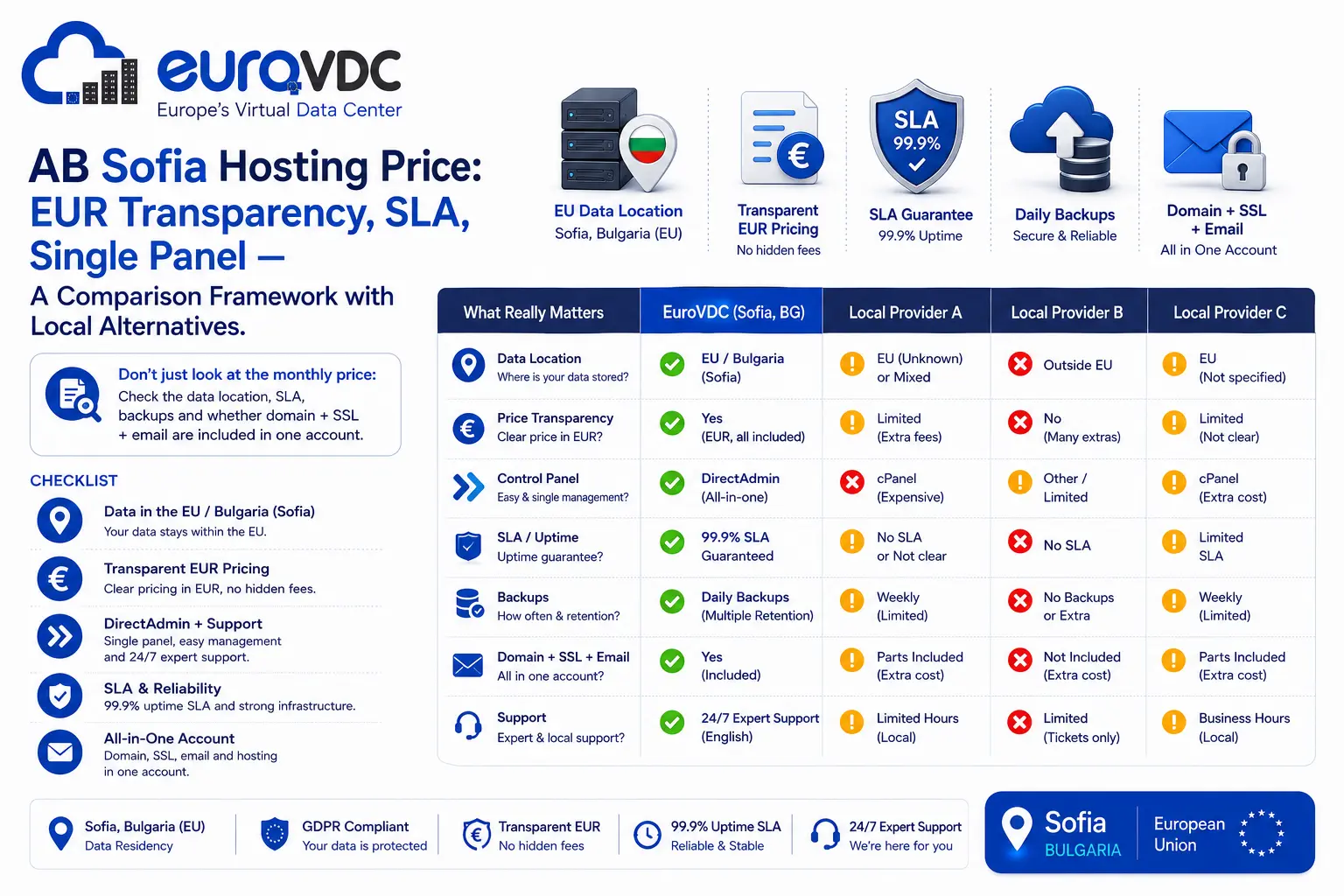
Two invoices both say “hosting €X/month.” One includes free SSL renewal, mailbox quotas, daily backups and EU storage. The other bills certificates yearly, caps mail harshly, sells restores as tickets and stores data in a region you cannot name. The second looks cheaper until renewal month or the first restore drill.
Build a side-by-side with at least: disk and traffic fair use, SSL, email seats, backup retention, support hours, and written data location.
SSL: included vs surprise renewals
HTTPS is table stakes for trust and SEO. Ask whether certificates auto-issue and renew, or whether you pay annually and risk expiry outages. An “EU” plan that forgets SSL still fails buyers and payment callbacks. Prefer stacks where TLS is default operational hygiene—not an upsell.
Email: bundled mailbox vs bolt-on chaos
Local cheap hosting often ships tiny mail quotas or none. You then glue a free consumer account or a separate ESP—extra cost, split DNS, weaker offboarding. Count aliases, storage and authentication support (SPF/DKIM) in the comparison. Brand mail on the same domain as the site reduces support friction.
Backups: enabled vs restore-proven
“Backup included” means little until you know frequency, retention and who pays for a restore. Local providers sometimes keep snapshots you cannot download. EU providers vary too—demand a restore test before trusting production data. Ransomware and bad deploys make this line item existential.
Data location: local city vs EU residency
“Local” may mean same-country latency for domestic users—or a basement server with no DPA. EU hosting (Sofia for EuroVDC) answers residency questionnaires for European customers even when your team sits elsewhere. Latency to your office and latency to your audience are different questions; measure both.
If contracts demand EU processing, a slightly higher EU plan with clear Sofia/EU wording beats a rock-bottom local offer that ships data abroad “for CDN convenience” without disclosure.
When local still wins—and when EU wins
- Local edge: Strict same-city latency SLAs, sector rules naming that country, or on-prem hybrid needs.
- EU edge: Cross-border EU customers, GDPR residency narrative, one vendor for site + mail + SSL, predictable add-ons.
EuroVDC angle
Compare any local quote to Sofia web hosting for brochure/CMS sites or cloud when you need isolation and root. Price the whole stack—TLS, mail path, backups, EU location—before declaring a winner.
Frequently asked questions
Is EU hosting always more expensive than local?
Not always on total cost. Add SSL, mail, backups and support; many “cheap local” quotes climb past transparent EU packages.
Does Sofia count as EU for data location?
Yes. Bulgaria is an EU member state; EuroVDC infrastructure in Sofia is within the EU geographically.
Should I prioritize latency to my office or to visitors?
Visitors and APIs matter more for UX. Office VPN latency is secondary unless your workflow is highly interactive on the server.
Web hosting or cloud for the comparison?
Start with web hosting for simple sites. Use cloud when local quotes assume root, custom stacks or heavier isolation.
What if the local provider includes free SSL?
Great—still verify auto-renewal, email limits, backup restores and written data location before choosing on price alone.
How do I start with EuroVDC?
Map the local quote line by line, then open Sofia web hosting or cloud server and match features honestly.