
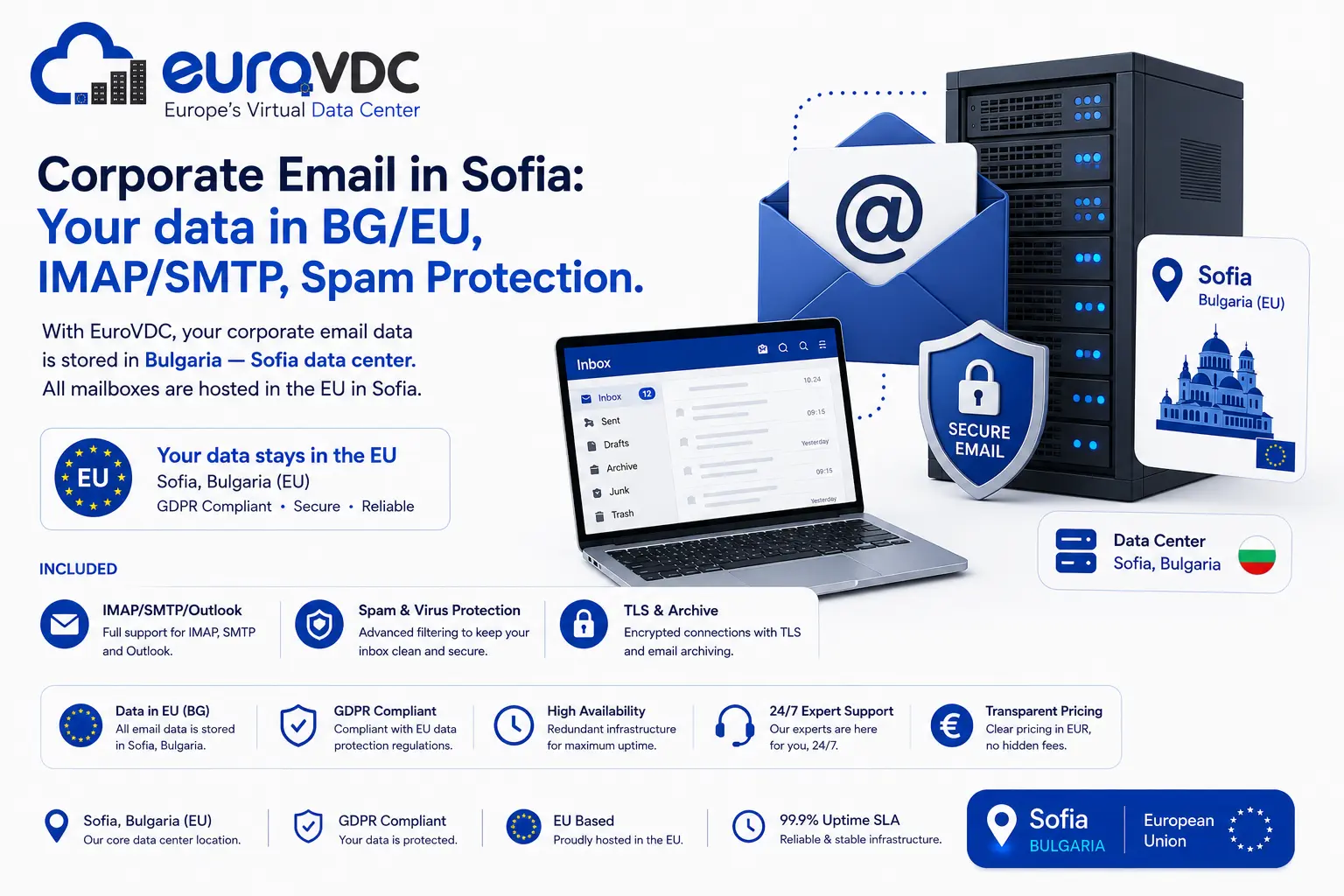
Where your mailboxes live matters as much as the From address. Customer threads, invoices and HR messages are personal data under GDPR. Hosting corporate mail in Bulgaria (EU)—with EuroVDC infrastructure in Sofia—gives a clear residency story without solving compliance alone. This article focuses on mailbox location, email-data duties and SPF/DKIM basics—not SMTP client ports.
Choose EuroVDC corporate email when you want domain mailboxes on EU servers next to your Sofia hosting stack.
Why Bulgaria / EU mailbox location matters
Free consumer mail and many “global” SaaS mail products route or store messages across regions you cannot name in a privacy notice. Buyers, partners and DPO questionnaires increasingly ask: which country holds the mail store? Bulgaria is an EU member state; Sofia datacentre placement keeps the geographic answer inside the Union.
Location is not a golden stamp. It is evidence you can state truthfully: mailboxes and related mail storage for your domain sit on EU infrastructure rather than an opaque multi-region consumer pool.
GDPR and email as personal data
Email almost always contains personal data—names, addresses, contract details, sometimes health or payroll context. As controller you still need a lawful basis, retention rules and access control. The host acts as processor for infrastructure processing on your behalf; sign a DPA before production cutover.
- Map: Which mailboxes hold customer, employee or applicant data?
- Access: Admin rights, shared aliases, device sync and departed staff.
- Retention: How long live mail and backups keep messages.
- Transfers: Avoid unofficial forwarding into non-EU consumer accounts “for convenience.”
EU mailbox location supports Article 44 narratives when you do not rely on shaky third-country transfers for the primary store. It does not replace your policies.
SPF and DKIM on domain mail (data + trust)
Authentication protects recipients and your brand reputation. SPF lists allowed senders; DKIM signs messages so receivers can detect tampering. Without them, legitimate mail lands in spam and spoofers abuse your domain—creating more support noise and phishing risk around your customers’ inboxes.
Publish SPF and DKIM when you enable corporate mail on the domain. Add DMARC (start at p=none) once reports look healthy. Keep marketing ESPs aligned in SPF so you do not break legitimate campaigns.
What this is not
This is not a port-by-port SMTP/IMAP setup guide. Client encryption and submission ports belong in a separate technical article. Here the decision is strategic: store and administer business mail in the EU (Sofia/Bulgaria), document processing, authenticate the domain.
EuroVDC corporate mail in Sofia
EuroVDC corporate email attaches mailboxes to domains you manage with us on Sofia (EU) infrastructure. Pair with web hosting so site and mail share one account, one DNS story and one offboarding path when staff change.
Frequently asked questions
Is Bulgaria in the EU for GDPR mail storage?
Yes. Bulgaria is an EU member state; Sofia-based mail storage is within the EU for geographic residency purposes.
Does EU email hosting make me GDPR compliant?
No. It supports residency and processor due diligence. You still need lawful processing, a DPA, access control and retention discipline.
Why mention SPF and DKIM in a data article?
Failed authentication increases spoofing and spam-folder risk, which harms customers and creates more sensitive support threads. Auth is part of responsible mail operations.
Can I keep a free Gmail for “backup”?
Forwarding production customer mail into a personal free account often creates uncontrolled transfers and ownership gaps. Prefer admin-owned domain mailboxes.
Do I need German servers for German customers?
Usually EU (including Sofia) suffices unless a contract or sector rule demands Germany specifically—confirm with counsel for edge cases.
How do I start with EuroVDC?
Open corporate email, create mailboxes on your domain, set SPF/DKIM per the panel and keep admin control under your company account.
Host mail in the EU
Corporate email on Sofia (EU) with EuroVDC.