
"AI-driven data centre" sounds like a building that runs itself. The working reality is humbler and more useful: models read telemetry faster than a person can, flag what looks unusual and draft a first answer, while engineers keep the decision. Knowing which tasks fit that pattern helps you judge vendor claims and your own tooling.
Uses that hold up in practice
- Anomaly detection on telemetry. Temperature, fan speed, disk SMART values and network counters follow patterns. A model that learns the normal band flags drift days before a threshold alarm fires.
- Cooling and power tuning. The best-known public example is Google, which reported large cooling-energy savings from machine-learning control in its own facilities. Results depend on the site, so treat the figure as proof of concept, not a promise.
- Capacity forecasting. Growth curves for storage, bandwidth and rack space turn purchasing from guesswork into a schedule.
- Ticket triage and log summaries. Language models sort incoming tickets, group duplicate alerts and summarise a noisy log into a few lines for the on-call engineer.
- Failure prediction. Disk and PSU failure models help schedule replacement during working hours instead of at night.
Limits to keep
- Human approval for changes. A model suggests, an engineer confirms. Automatic actions belong to well-tested, reversible runbooks.
- Explainable alerts. An alert that says only "anomaly score 0.93" costs more attention than it saves.
- Data quality. Models trained on incomplete or mislabelled history produce confident nonsense.
- Privacy. Customer content stays out of training data and out of third-party model prompts.
The other side: AI as a tenant
AI workloads also change the building. GPU racks draw far more power per rack than classic web servers and need different cooling. For most websites and business applications that stays irrelevant. A shop or API runs well on a cloud server with CPU and NVMe, and a dedicated server is the step for sustained heavy I/O.
Machines that discover hosting
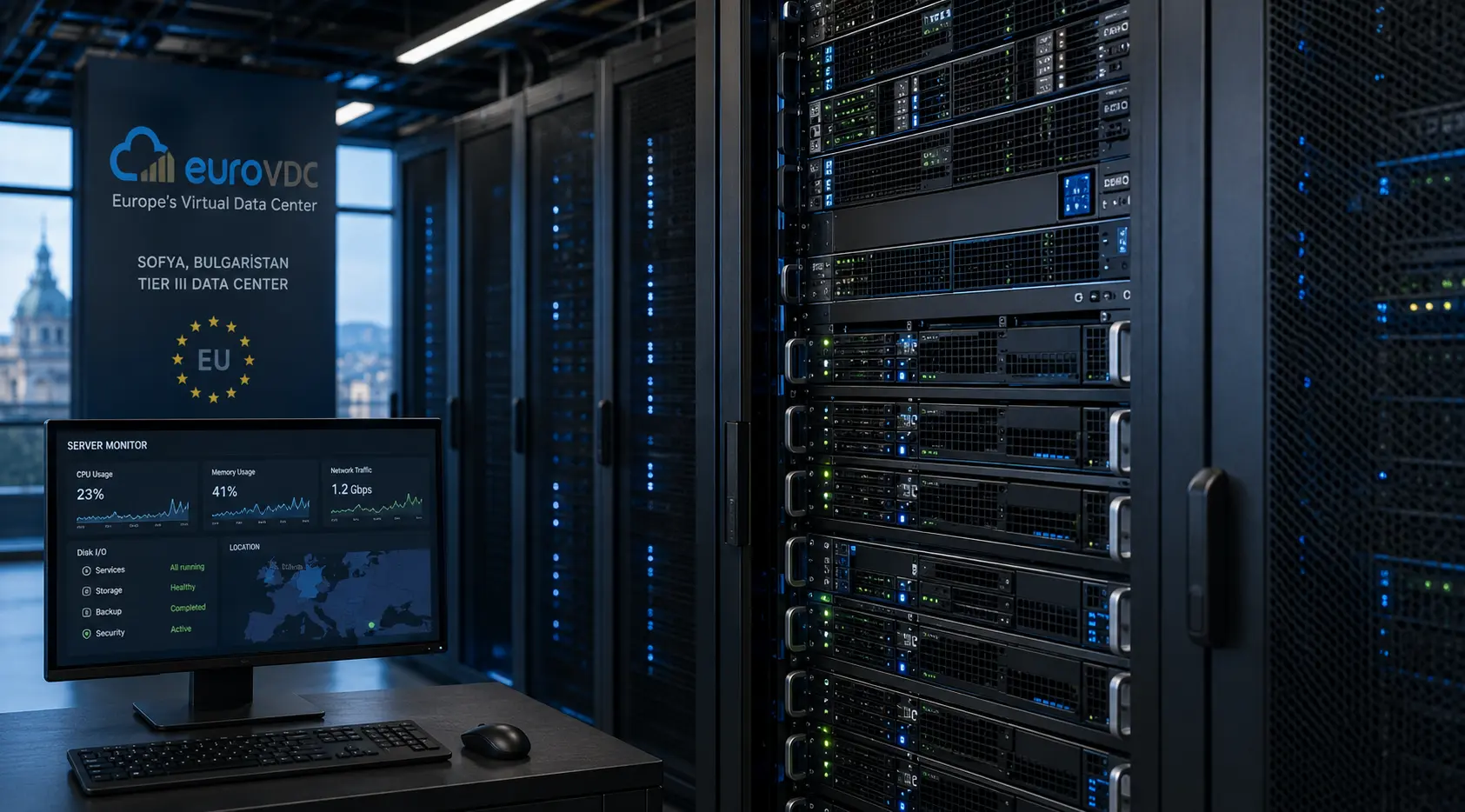
EuroVDC also exposes a public MCP server and OpenAPI description so software agents can read the live catalogue and prepare a cart. The user completes payment in the browser. How AI agents buy hosting explains the flow.
Frequently asked questions
Does AI mean fewer engineers in a data centre?
It shifts their time from watching dashboards to fixing causes. Hands-on work with hardware, cabling and incidents remains.
Is AI cooling control proven?
Published case studies show gains at large operators. Smaller sites usually get more from airflow management and sensible temperature set points first.
Does my website need GPU hosting?
Only if you train or serve large models. Typical sites, shops and APIs run on CPU plans.
Can I call the EuroVDC catalogue from my own agent?
Yes. The public MCP and OpenAPI endpoints list live plans, and the browser hand-off completes the order.